What is Cap Rate? The Complete Guide to Capitalization Rate
Cap rate measures a rental property's income relative to its value. Learn the formula, see worked examples, and understand what makes a good cap rate by market and property type.
Cap rate — short for capitalization rate — is one of the first numbers every real estate investor learns. It answers a deceptively simple question: how much income does this property produce relative to what it costs?
If you can read a cap rate, you can quickly compare properties across markets, asset classes, and price points without getting lost in mortgage math. This guide covers everything you need: the formula, worked examples, benchmarks by property type, and the situations where cap rate falls short.
The Cap Rate Formula
The formula has just two inputs:
Cap Rate = Net Operating Income (NOI) ÷ Property Value × 100
- Net Operating Income (NOI) is your gross rental income minus all operating expenses. Operating expenses include property taxes, insurance, property management fees, maintenance, vacancy allowance, and any utilities you pay. NOI does not include mortgage payments — debt service is excluded by design.
- Property Value is typically the purchase price, though you can substitute current market value when evaluating an existing holding.
Breaking Down NOI
Before you can calculate cap rate, you need accurate NOI. Here is how to build it:
| Line Item | Annual Amount |
|---|---|
| Gross Rental Income | $24,000 |
| Less: Vacancy (5%) | −$1,200 |
| Effective Gross Income | $22,800 |
| Less: Property Taxes | −$3,600 |
| Less: Insurance | −$1,200 |
| Less: Property Management (8%) | −$1,824 |
| Less: Maintenance Reserve (1%) | −$2,000 |
| Less: CapEx Reserve (0.5%) | −$1,000 |
| Net Operating Income | $13,176 |
With a purchase price of $200,000 and an NOI of $13,176, the cap rate is:
$13,176 ÷ $200,000 × 100 = 6.6%
Worked Examples
Example 1: Single-Family Home in the Midwest
- Purchase price: $175,000
- Monthly rent: $1,600 ($19,200/year)
- Vacancy allowance: 8% (−$1,536)
- Operating expenses: $6,400/year (taxes, insurance, management, maintenance)
- NOI: $19,200 − $1,536 − $6,400 = $11,264
- Cap Rate: $11,264 ÷ $175,000 = 6.4%
Example 2: Small Multifamily in a Tertiary Market
- Purchase price: $420,000
- Monthly rent (4 units × $900): $3,600 ($43,200/year)
- Vacancy allowance: 5% (−$2,160)
- Operating expenses: $14,500/year
- NOI: $43,200 − $2,160 − $14,500 = $26,540
- Cap Rate: $26,540 ÷ $420,000 = 6.3%
Example 3: Luxury Condo in a Coastal Market
- Purchase price: $650,000
- Monthly rent: $3,400 ($40,800/year)
- Vacancy allowance: 4% (−$1,632)
- Operating expenses: $15,000/year (high HOA, taxes, management)
- NOI: $40,800 − $1,632 − $15,000 = $24,168
- Cap Rate: $24,168 ÷ $650,000 = 3.7%
The luxury condo has a lower cap rate not because it is a bad investment, but because buyers are paying a premium for perceived safety, liquidity, and appreciation potential. Markets price that in.
What Makes a “Good” Cap Rate?
There is no universal answer — cap rates are relative to market conditions and property type. That said, here are the general benchmarks investors use:
| Cap Rate | What It Signals |
|---|---|
| Below 4% | Major coastal market, premium asset; thin income cushion |
| 4%–5% | Mid-tier market or high-quality asset; moderate cash flow |
| 5%–7% | Solid income-producing property; most investors’ target range |
| 7%–10% | Secondary or tertiary market; higher yield, higher risk |
| Above 10% | Distressed, older, or high-crime area; price the risk carefully |
A 6% cap rate in Kansas City signals something different than a 6% cap rate in Manhattan. In Kansas City, 6% might be below market. In Manhattan, it would be extraordinary.
Cap Rate by Property Type
Different asset classes trade at different cap rates because of their risk profiles:
Single-Family Rentals (SFR): 5%–8% in most markets. Lower vacancy risk (tenants stay longer), but concentrated — one vacancy = 100% income loss.
Small Multifamily (2–4 units): 5%–8%. Similar to SFR but with some income diversification. Popular with house-hackers.
Apartment Buildings (5+ units): 4%–7% in primary markets, 6%–10% in secondary. Professional management matters more here.
Short-Term Rentals / Airbnb: Cap rate is harder to apply because income fluctuates. Use RevPAR (revenue per available room) and a conservative occupancy assumption instead.
Commercial / Retail: 5%–9%. Longer leases but tenant credit risk can be severe.
Industrial / Warehouse: 4%–6% in most markets. Currently compressed due to e-commerce demand.
Using Cap Rate to Value a Property
Cap rate is reversible — you can use it to estimate what a property should be worth:
Property Value = NOI ÷ Cap Rate
If similar properties in your market trade at a 6.5% cap rate and the property you’re analyzing has an NOI of $18,000:
$18,000 ÷ 0.065 = $276,923
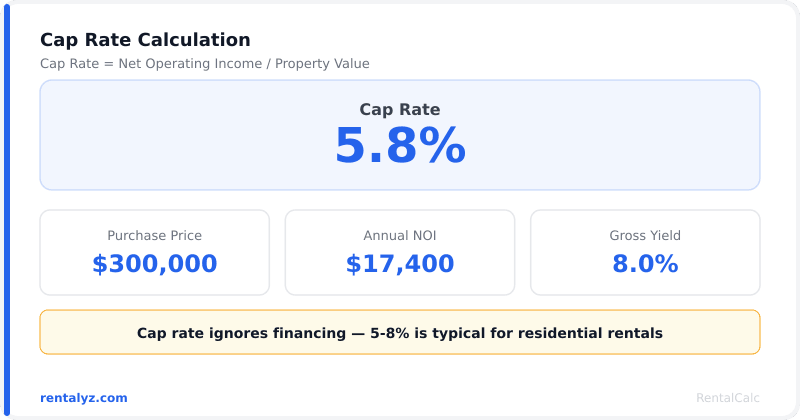
If the seller is asking $310,000, you now know you’d be buying at a 5.8% cap rate — below market. That’s not necessarily wrong, but it’s a number to negotiate from.
Cap Rate vs. Other Metrics
Cap rate is one tool among several. Here’s how it compares:
Cap Rate vs. Cash-on-Cash Return: Cap rate ignores financing. Cash-on-cash return measures the actual cash yield on your equity after debt service. If you use a mortgage, cash-on-cash is usually more relevant to your actual returns.
Cap Rate vs. Gross Rent Multiplier (GRM): GRM is gross income ÷ price. It’s faster to calculate but ignores expenses. Cap rate is more accurate.
Cap Rate vs. Total ROI: Total ROI captures appreciation, equity paydown, and tax benefits — things cap rate ignores. Use cap rate for quick comparisons; use total ROI for full investment analysis.
Common Cap Rate Mistakes
Mistake 1: Using gross income instead of NOI. The cap rate means nothing if you haven’t subtracted expenses. Including a vacancy allowance and maintenance reserve is non-negotiable.
Mistake 2: Forgetting CapEx reserves. A new roof costs $15,000. If you don’t budget for it, your “cap rate” is artificially inflated and you’ll be caught off-guard.
Mistake 3: Applying one market’s benchmarks to another. A 5.5% cap rate is excellent in San Francisco and mediocre in Memphis. Always compare apples to apples.
Mistake 4: Using list price instead of purchase price. Calculate cap rate at the price you actually pay (or expect to pay), not the asking price.
Mistake 5: Ignoring market cap rate trends. Cap rates compress when prices rise faster than rents. If the market has moved from 7% to 5% caps over five years, appreciation drove that — not income growth.
When Cap Rate Doesn’t Apply
Cap rate works best for stabilized income-producing properties. It breaks down in several situations:
- Fix-and-flip properties — No stabilized income stream yet.
- Owner-occupied homes — They don’t produce rental income.
- Raw land — No income at all.
- Short-term rentals with highly variable occupancy — Income swings too much for a single annual NOI to be meaningful.
- Properties under renovation — Temporary income disruption makes the current cap rate meaningless.
For these situations, use metrics suited to the investment type: the 70% rule for flips, RevPAR for short-term rentals, IRR for development deals.
Frequently Asked Questions
Q: What is a good cap rate for a rental property?
Most investors target 5%–8% for residential rentals. Below 4% is common in high-cost coastal markets where appreciation drives returns. Above 10% often signals elevated risk.
Q: Does cap rate include the mortgage?
No. Cap rate uses NOI, which excludes mortgage payments. This makes cap rate a property-level metric independent of financing. For returns after debt service, use cash-on-cash return.
Q: Is a higher or lower cap rate better?
Higher cap rate = more income relative to price, but often higher risk. Lower cap rate = you’re paying a premium for stability or appreciation. Neither is universally better.
Q: What expenses are included in NOI?
Property taxes, insurance, property management, maintenance, vacancy allowance, and CapEx reserves. Mortgage payments and depreciation are excluded.
Calculate Cap Rate for Your Property
Use our free cap rate calculator to run the numbers on any rental property — no signup required.